Protect Your Home From Hard Water
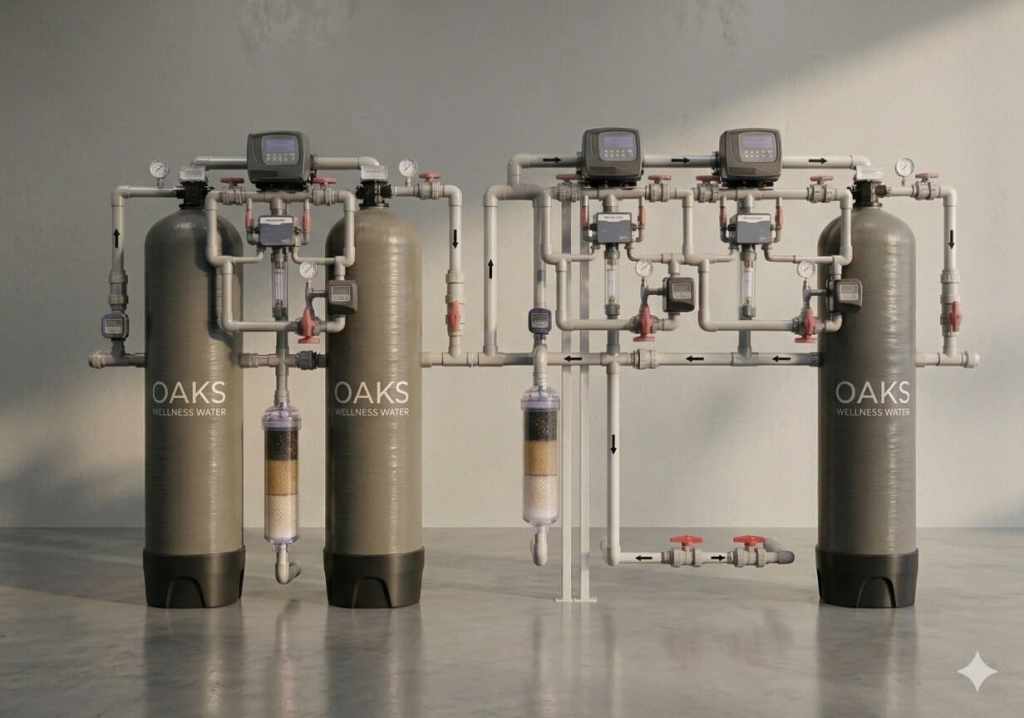
After researching and considering water quality in Ontario, OAKS offers various water softeners to our customers.
Most people in Ontario use hard water, which has a large amount of calcium and magnesium in it, and this may cause a lot of problems, such as health issues, dry skin, frizzy hair, and scale buildup on tiles, crockery, and in appliances.
So, it is time to install a water softener in your home.
Water softeners are available in two types:
- Salt-based water softener
- Salt-free water softener
Both of them have some pros and cons, as every other system does.
What Is a Salt-Free Water Softener?
A salt-free water softener is an eco-friendly and smart solution to resolve the problem of hard water. It offers an innovative approach to soften the Ontario hard water.
Salt-free water softener is a commonly used term, but technically it is called a water conditioner.
A water conditioner is a water treatment system that conditions the water by removing hard minerals in such a way that they do not stick to the surface and appliances; rather, they just pass through it, and no scales form on it.
Saltless water softener systems use template-assisted crystallization technology that converts the hardening minerals into tiny crystal forms that do not stick to the surfaces easily.
Sometimes it also uses carbon filters that remove chlorine, pesticides, and herbicides but not the dissolved minerals. Hence, you can modify your system according to your needs.
Key Components
A salt free water conditioner is a simple system with the following components:
- Conditioning media
- Pre-filtration system
- Carbon filters (if needed)
- Whole-house water softener installation setup
How Do Salt-Free Water Softeners Work?
There is no tough science or process behind the working of salt-free water softeners. The water-hardening minerals remain in the water. The system does not work to remove them.
It just uses the TAC conditioning media to change the nature of minerals and convert them into microscopic crystals that cannot attach to the surfaces to make scales on the plumbing surfaces. It benefits you by preventing scale buildup in your appliances, on tiles, and on glassware.
What Salt-Free Systems Do Not Do
No salt water softener systems do not remove hardness minerals; hence, in the water test you will see the same hardness readings. They do not provide you with soft water in the traditional sense, so they do not help with problems of soap not lathering well and dry skin and hair.
You need to consider the pros and cons of salt-free water softeners before installing them in your home or workplace for maximum benefits and the best experience.
Find your perfect system.
Your local Oaks experts will provide personalized recommendations for the right solution for your home.
Pros of Salt-Free Water Softeners
A salt free water softener system comes with a lot of benefits for you, your family and the environment:
No Salt Required
As it is a non salt water softener system, you don’t need to refill salt in it. No salt means no hassle purchasing the best-quality salt and lifting the heavy bags of salt, and lower ongoing maintenance and operational costs.
Environmentally Friendly
As the salt free water softeners do not use any type of salt to soften the water, there is no brine discharge during the water softening process, and no wastewater is produced. Hence, it is an eco-friendly operation, saving your water and protecting your environment. It is recommended for regions that restrict salt-based water softeners due to brine discharge.
Low Maintenance Requirements
The whole-house water softeners without salt do not work on the principle of the regeneration cycle, and there is no need for salt refills, which results in low maintenance requirements, and these systems work efficiently with longer maintenance intervals.
No Electricity Needed
Salt less water softeners have a simple mechanical design and need no electricity to operate hence, they work during power outages too. It lowers your monthly utility costs.
Helps Reduce Scale Buildup
These systems specifically work to convert the hardening minerals into microscopic crystals that do not stick to the plumbing surfaces, hence providing you with protection for your plumbing and valuable appliances like water heaters, washing machines, and coffee makers. It improves the efficiency of appliances by reducing scaling in them.
Preserves Healthy Minerals
A lower quantity of calcium and magnesium is important for your health, and salt-free water conditioners do not remove these minerals from water and hence prove beneficial for your and your family’s health.
Compact Design
Being compact and with a simpler design, it requires less floor space for installation and is suitable for smaller utility rooms.
Cons of Salt-Free Water Softeners
Like all other systems and appliances, a salt-free water softener also has some limitations that need to be considered before choosing it:
Do Not Actually Soften Water
The most important drawback of a water conditioner is that it just conditions calcium and magnesium rather than removing them from water. So it does not provide you with true soft water. The water hardness test shows the same hardness readings, so you do not completely eliminate water hardness.
Limited Effectiveness in Very Hard Water Areas
If the available water is very hard, the performance of a salt-based water softener becomes limited, and it does not work properly to completely prevent scale buildup on plumbing surfaces.
If you are living in very hard water areas, it is recommended to use salt-based traditional water softeners after checking the regional water considerations.
Soap Efficiency May Not Improve
As these systems do not remove hardening minerals, soap efficiency may not improve, and you still get dry skin, frizzy hair, and stiff laundry.
Existing Scale Is Not Removed
A salt-less water softener can prevent future scale buildup on plumbing surfaces but does not work to remove existing scale. Hence, you need separate cleaning for the existing scale on tiles, crockery, and appliances.
Higher Initial Purchase Cost
A salt-free water softener is more expensive than a salt-based water softener. Although it may prove cost-saving in the long term with low maintenance costs, the initial purchase cost of this system is always more than that of a salt-based traditional water softener.
Results Can Be Difficult to Measure
It is very difficult to measure the results of the installation of a salt-less water softener, as the hardness readings remain the same, and you can only evaluate the performance on the basis of scale reduction. Usually, its performance does not meet the homeowner’s expectations.
Salt-less Water Softeners vs. Traditional Water Softeners
Before choosing between the salt-less water softener and traditional salt-based water softener, you need to consider a comparison of both of them in terms of their benefits, cost, and maintenance:
Feature | Salt-Free System | Salt-Based Softener |
Removes Hardness Minerals | No | Yes |
Prevents Scale | Yes (partially) | Yes |
Uses Salt | No | Yes |
Requires Electricity | Usually No | Yes |
Produces Wastewater and Brine Discharge | No | Yes |
Maintenance | Low | Moderate |
Water Feels Soft | No | Yes |
Suitable for Extremely Hard Water | Limited | Excellent |
Initial Cost | High | Low |
Which Option Is Better?
No one option can be best for everyone. A better option is one that meets your needs. It entirely depends on your desired water quality.
If your household is seeking just scale reduction and wants to install a system that requires less maintenance and lower operational costs, it is recommended to install a salt-free water conditioner.
On the other hand, if you are living in an area where available water is very hard, and you need to get rid of hard water in a real sense with full benefits, it is recommended to install a salt-based water softener.
Find your perfect system.
Your local Oaks experts will provide personalized recommendations for the right solution for your home.
Who Should Buy a Salt-Free Water Softener?
Ontario people use city municipal water or well water. Both types of water can be hard, but the hardness level may be different. You need to consider that a salt-free water softener is ideal in some conditions but not ideal in others before buying it.
Salt-free water softeners are ideal for:
- Environmentally conscious homeowners
- Homes with moderate hard water
- Areas with brine discharge restrictions
- People seeking low maintenance of the system
But it may not be ideal for:
- Extremely hard water regions
- Homeowners wanting true soft water for drinking purposes
- Households seeking maximum soap efficiency
How is water hardness measured?
Sulfur can be detected by a rotten-egg smell in the water, and iron by a tinted appearance. Whereas, it is somewhat difficult to measure the water hardness by just seeing or smelling the water. You need to have a laboratory test to check the hardness level of the available water.
Final Verdict
To resolve the problem of hard water, it is necessary for you to install a water softener in your home.
If you just want to get rid of scale buildup, a salt-free water softener is the best option with low maintenance costs, but if you want true soft water, it is recommended to choose a salt-based water softener for your home.
Feel free to contact an OAKS expert for professional advice regarding choosing the NSF-certified system according to your needs.
Find your perfect system.
Your local Oaks experts will provide personalized recommendations for the right solution for your home.
FAQs
Do salt-free water softeners actually work?
Salt-free water softeners just condition the hardness minerals and prevent them from sticking to the surfaces. It does not remove the calcium and magnesium from water, so it can’t provide you with true soft water.
What is the biggest disadvantage of a salt-free water softener?
The biggest disadvantage of a salt less water softener is that it can’t remove calcium and magnesium and hence is not ideal for drinking purposes.
Are salt-free water softeners better than traditional salt-based softeners?
It is totally dependent on your goals and desired water quality. Salt-based water softeners remove calcium and magnesium, while salt-free water softeners just condition them to prevent scale buildup.
Can a salt-free water softener remove lime-scale buildup?
No, a salt-free water softener can’t remove existing lime-scale buildup but can prevent new scale buildup on your tiles and water-using appliances.
Do salt-free water softeners require regular maintenance?
Yes, they also require regular maintenance but less frequently than a traditional water softener.
How long does a salt-free water softener last?
A salt-free water softener lasts about 10-20 years or more with better maintenance habits.
Written by Joseph Mroueh
Joseph, founder of Oaks, develops high-quality whole-home and drinking-water filtration systems. He focuses on delivering reliable, clean, and safe water solutions for modern households.
Share