
Hard water is a silent problem, especially in those Canadian areas where people use municipal or well water. You may notice white scale on faucets, scale buildup in appliances, dry skin, frizzy hair, and scale on dishes.
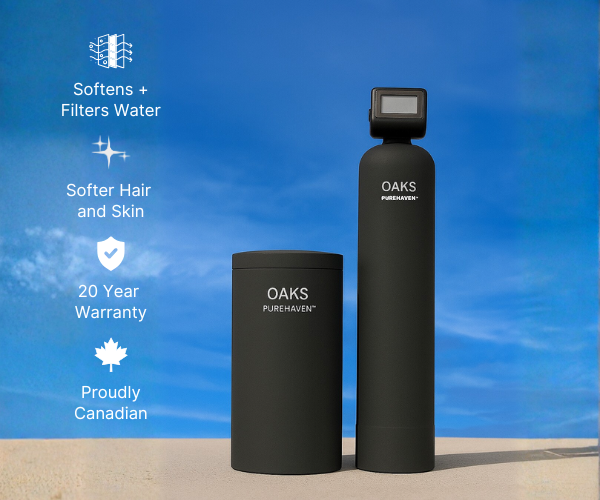
Like every problem, this one has a solution. Install an Oaks Water Softener to soften your water. Water softeners may be of two types:
- Salt-based Water Softener
- Salt-free Water Softener/ Salt Free Water Conditioner
Salt-based water softeners require salt to work properly and require more maintenance. In contrast, salt-free water softeners are eco-friendly systems with minimal maintenance requirements, offering many benefits.
The no-salt water softener actually doesn’t remove calcium and magnesium, but converts them into microcrystal. It prevents scale buildup in your appliances, providing better-tasting, odor-free water, smoother laundry, and smoother skin and hair. It is also used for drinking purposes if your family is not allergic to calcium and magnesium.
What Is a Salt Free Water Softener?
A salt-free water softener is not, in fact, a true water softener because it does not remove calcium and magnesium in the real sense. It just makes the microcrystal of extra minerals flow with water. So, you can say that such systems are technically water conditioners.
These systems are installed at the point of entry as whole-house water softeners to provide you with scale-stopping, softened water in every tap at your home.
How Does a Salt Free Water Softener Work: The Truth about Saltless Water Softeners?
A salt-free water softener works on the principle of template-assisted crystallization. Unlike other salt-based water softeners, it does not use the ion-exchange method to remove calcium and magnesium from water.
It just makes the minerals’ crystals and allows them to enter the water. These crystals remain in the water unbroken and pass through the water pipes, and appliances, and do not stick in them to make white scales. It does not affect the soap lather to a great extent, providing you with smooth laundry, smoother skin, and smoother hair.
As it does not remove minerals or soften the water in a real sense, it is typically called a salt-free TAC water conditioner that changes the condition of minerals from dissolved to microcrystalline.
Step-by-Step Working Process of Salt-Free Water Softener
A salt-free water softener is a simple scale-prevention system that works on a very simple process.
- The available hard water enters the system’s tank.
- The tank contains a medium that basically works to change the mineral’s condition. It accumulates the extra calcium and magnesium and forms their microcrystals.
- When the microcrystals become large enough, they pass through the media and enter the water.
- These crystals flow with water in your homes and flow through plumbing instead of sticking in it to make white scales.
As it uses no ion-exchange method, there are no regeneration cycles, which will obviously save you time and energy. There is no brine tank, and there is no need to refill the salt again and again. Most simple models don’t require any electricity to work.
Salt vs. Salt-Free Water Softener: Which is Better?
When you have two water softener systems for the same purpose, you need to compare them to choose the one that best meets your needs. You need to understand the working principles of both systems.
Salt-Based Water Softener System: A True Softener
Salt-based water softeners use ion exchange to remove minerals by replacing them with sodium ions. The extra calcium and magnesium are removed during the regeneration cycle, leaving you with soft water free of those minerals but with a bit more sodium.
It requires salt and a regeneration process to work properly, and you have to refill the salt and allow more time for maintenance, i.e., refilling and changing the brine tank. It produces a lot of wastewater during the regeneration cycle to finally remove calcium and magnesium.
It is not an eco-friendly system, as it releases a large amount of chloride into drainage water, threatening fresh water, aquatic life, and land. For this reason, it is also banned in most Canadian areas.
It also disturbs your budget with regular salt refilling, costly maintenance, and increased electricity use during regeneration, all of which happen again and again.
You need to choose a specific installation location with access to a drainage pipe, power supply, and enough space to adjust the system’s tanks.
Salt-free Water Softener System: A scale stop softener system
Salt-free water softeners use modern TAC technology to alter the structure of calcium and magnesium rather than removing them from the available water. It just focuses on preventing scale buildup in appliances, faucets, and dishes.
It doesn’t require any salt, as it doesn’t work on the principle of ion exchange, which requires salt. You do not need as much regular maintenance as you need for salt-based water softeners.
No regeneration cycles are occurring in these systems, so there is no wastewater. It is eco-friendly and budget-friendly for you. Most systems don’t need any electricity to work.
It is a very simple system and does not require a drainage pipe. So, you can choose the installation location based on the available space.
Which system is stronger?
If it is a discussion of salt-based vs. salt-free water softeners, you need to choose the best customized Oaks Wellness Water system that best meets your needs and goals.
For hard water and well water with iron and other contaminants, a salt-based water softener is preferred, as it can be customized to remove contaminants other than calcium and magnesium.
Whereas, if the goal is appliance protection, a salt-free water softener is preferable, as it is eco-friendly and budget-friendly and delivers the same results.
Pros and Cons of Salt-Free Water Softeners
Like every other water treatment system, there are a lot of pros and cons of salt free water softener systems.
Pros:
Due to its simple technology and mechanism, salt free water softeners added a lot of benefits in your life.
Simple Installation
Salt-free water softeners are simple systems with no brine tank, moving parts, or valves. It requires a simple installation process and may reduce your labor costs if you are experienced at repairing appliances yourself.
Space saving design
It is a simple system with no extra tanks like in other water treatment systems. It is a space-saving system that you can install wherever you want.
Cleaner faucets and tiles
A salt free water softener specifically works for the prevention of scales buildup on surfaces and gives you cleaner faucets, dishes and tiles.
Long life appliances
As it prevents scale formation in appliances, it will obviously increase the life span of your appliances providing you comfort and peace of mind.
Smooth laundry, skin and hair
It does not allow the salts to stick on the laundry, your skin and hair. It provides you with smoother laundry, skin and hair eventually.
No salt handling
As it just crystallizes the minerals and needs no salt to exchange the mineral with ion, so there is no need for salt refilling.
No electricity usage
Most of the systems just work with water pressure and TAC media and do not require electricity to work. It has no extra burden on your electricity bills and works during power outages too. It provides you more convenience.
No wastewater discharge
There is no regeneration cycle, so there is no waste water discharge. It does not require you to find a space for installment where the drainage pipe is necessary. It will also reduce the water bills eventually.
Low maintenance
There is no salt usage in the system, so it requires low maintenance. There is no brine tank to clean and regeneration programming. You need to replace only TAC media. It increases the life span eventually.
Environmentally Friendly
There is no wastage water, no brine tank and no salt usage. So, it is an eco-friendly system as compared to other water treatment systems.
Cons:
Along with the benefits, the salt free softener system has some limitations too.
Not true soft water
It just crystallizes the extra minerals, and does not remove them so it does not provide you with true soft water.
Limited effectiveness in very hard water
Its effectiveness is very limited in very hard water and for the well water containing iron and other contaminants.
Boiling water may break the crystal structure
If the water is boiled at high temperature, the mineral crystals may break down causing scale formation in kettle and water heaters.
How Long Does a Salt Free Water Softener Last?
Unlike salt-based water softeners, salt-free softeners are simple systems that require less maintenance, so their lifespan is significantly longer.
The lifespan of saltless water softeners is just 2 figures: 15-20 years and 3-5 years. The system unit lasts 15-20 years, and the TAC media used to crystallize the minerals lasts 3-5 years. But this life span depends upon some factors:
Presence of Iron and other contaminants in water
If the available water contains iron and other contaminants, such as sediments and microplastics, they may shorten the system’s lifespan.
Water Acidity
If the available water is acidic, its acidity will affect the entire system and shorten the TAC’s lifespan.
Maintenance Habits
If the system is maintained regularly, and the TAC media is changed after a specific span of time, the system will work efficiently for a longer time.
It is recommended to test your water before installing the Oaks Salt-free water softener, add pre-filtration stages if needed, and replace the media regularly for better results and to increase the lifespan of the system unit.
Cost of a Salt Free Water Softener
Salt-free water softener costs depend on the system size. Its unit cost ranges from $1,000 to $3,000. You need a professional installation to fix the system in your home. It needs $300-$1,000 labor charges. Some of the costs you need annually for maintenance, as you need to clean it and replace the media every 3-5 years.
When it comes to cost, a salt-free water softener is more affordable than a salt-based system. The unit cost may be the same, but salt-based water softeners incur higher maintenance costs than salt-free water softeners. It requires more water for regeneration, increasing electricity and water bills. It needs regular salt refills and brine tank replacements.
When is a Salt-Free Water Softener worth it?
The selection of the best system depends on your needs, goals, and comfort. Some conditions indicate you should choose a salt-free water softener.
You want scale prevention only
A salt-free water softener is specifically designed to change the condition of minerals, preventing them from sticking to surfaces and in appliances, which can cause white scale buildup. If your main goal is to prevent scale in the home, you should install a salt-free water softener.
You live in a brine-restricted area
A salt-based water softener uses a brine tank that adds chloride to the drainage water, which is not eco-friendly. It contaminates fresh water and aquatic life, and it also affects the land. For this reason, salt-based water softeners are restricted in many areas of Canada. If you live in such a brine-restricted area, you should choose a salt-free water softener.
You are city water users
City water is well-treated and free of iron and other contaminants. It contains less calcium, magnesium, and other contaminants than well water. Hence, a salt-free water softener is the best system for you if the water in your city is municipal water.
You want an eco-friendly solution
If you need to get rid of hard water but want an eco-friendly solution, consider a salt-free water softener, as it produces no wastewater, consumes less electricity, and adds no salts to drainage water.
You dislike the slippery feel of the water
Hard water gives you a bad, slippery taste. If you dislike this type of bad taste and want to improve your water’s taste, you should install a salt-free water softener in your home.
On the other hand, if you use well water and want true soft water with no calcium or magnesium, the salt-free water softener is not worth it. In this case, you need to choose a salt-based softener rather than a salt-free softener.
Final Verdict
A salt-free water softener is the best choice if you want to prevent scale buildup in your appliances and water pipes. It is a budget-friendly, eco-friendly system compared to salt-based water softeners. You may add pre-filtration as needed. But if you are very, very conscious that you want to remove calcium and magnesium with 100% accuracy, you should choose a salt-based system.
If you are confused about selecting a system and want a customized system tailored to your home’s needs, contact Oaks Wellness Water for professional advice.