Get Expert Advice on Water Softeners
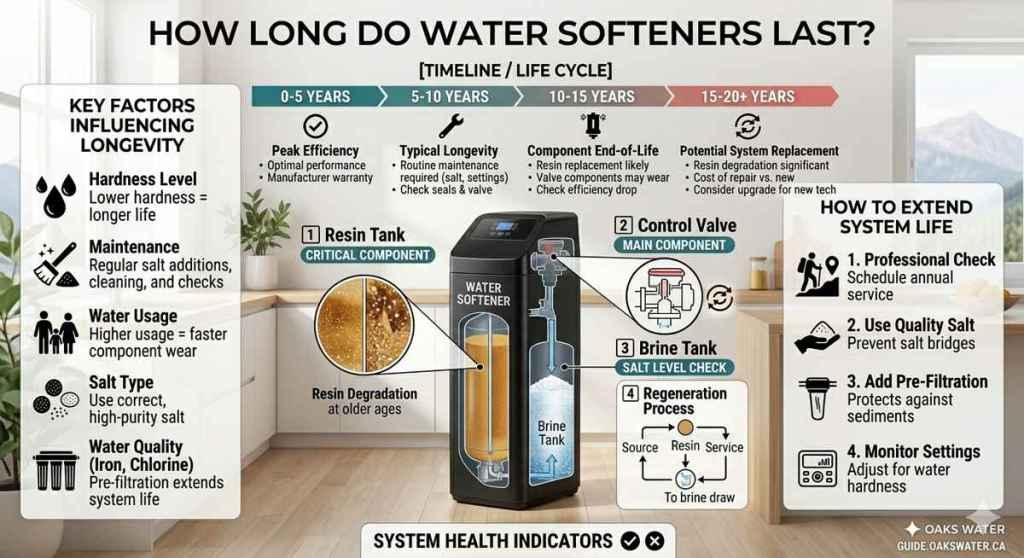
If you buy the right water softener for your home and maintain it regularly, you can save money for 10-15 years.
You may face problems like soap not lathering properly, dry skin, and stiff laundry build-up on your tiles and your Crockery, even after installing the water softener. These problems mean that your water softener is not working properly.
After installing the water softener, you need to know how long it lasts and how often you need to clean and maintain it to extend its lifespan.
Usually, a modern water softener lasts about 10 to 15 years. While a premium, high-quality OAKS system lasts about 20 years or more with regular and proper maintenance.
We can’t give a single figure for the lifespan of a water softener, it depends on factors like maintenance, the condition of the system, water quality, and daily water usage.
What Is the Average Lifespan of a Water Softener?
Usually, the Water Softeners used in the home last about 10 to 15 years.
If the system is of good quality and from a reputable company, your water is not very hard, and you maintain it regularly, it lasts about 20 years.
Water Softener and Its Parts | Average Lifespan |
Salt-Based Softener | 10–15 Years |
Dual-Tank System | 15–20 Years |
Salt-Free Conditioner | 10–20 Years |
Resin Tank | 10–15 Years |
Control Valve | 8–12 Years |
What Affects the Lifespan of a Water Softener?
Factors that affect the lifespan of your water softener include water hardness, water quality, well water, municipal water systems, system quality, water usage, and regeneration frequency.
Water Hardness Levels
The lifespan of a water softener depends heavily on water hardness. The more calcium and magnesium are present in the water, the more it has to remove these extra minerals.
Due to harder water, the system has to regenerate more often. Resin will wear out faster. The system will use more salt, leading to overburdening.
You need to take into account that if you are living in an area where the water is much harder, the lifespan of the water softener could be short.
Water Source (Well vs Municipal)
The water source also affects the lifespan of the water softener.
Well water contains iron, sand, and other minerals in greater quantities, which accumulate in the water softener and affect its performance. In contrast, municipal water is cleaner than well water, and it does not affect the system as much; it lasts longer with municipal water than with well water.
Quality of the System
A cheaper, lower-quality system requires more maintenance and may cause water tank leaks earlier.
A premium-quality water softener lasts longer, requires less maintenance, and provides better efficiency for a longer time.
Frequency of Regeneration
The type of water softener system also affects its lifespan. If your system is a demand-based regenerative system, it will last longer than one with a high regeneration frequency.
Frequent regeneration requires more salt and more resin, and in turn wastes salt and water. The system’s efficiency is also affected.
Maintenance Habits
If the water softener is not properly cleaned and maintained, it can disrupt the system. Salt Bridges and mushes will wear out the system earlier, and contaminants will accumulate in the tank.
A well-maintained system lasts much longer than a poorly maintained one along with providing you with softer, cleaner and hotel-quality water.
Find your perfect system.
Your local Oaks experts will provide personalized recommendations for the right solution for your home.
Signs Your Water Softener is Going Bad
There are some signs through which you may know that your water softener needs to be replaced soon:
- Hard Water Problems Return
- Increased Salt Usage
- Low Water Pressure
- Strange Noises or Constant Running
- Resin Bead Failure
- System Age Over 10–15 Years
How to Extend the Life of Your Water Softener
There are several ways to extend the lifespan of your whole house water softener system.
Use High-Quality Salt
Use the highest-quality, recommended salt. A good quality salt will prevent the formation of salt bridges and mushes in the system. It keeps the system clean and protects the resin beads.
Clean the Brine Tank
Clean the brine tank regularly. First, empty the brine tank, break up the accumulated salt, and remove sludge and residues.
Replace Resin
Replace the resin when needed. Usually, you need to replace a resin every 8 to 10 years. If you don’t replace it, your whole system unit will be affected.
Install a Sediment Pre-Filter
If you are using the well water in your houses, it is recommended to install sediment pre-filters to prevent your main filtration membranes from additional contaminants, sediments, and sand particles.
Schedule Annual Maintenance
Schedule professional maintenance every 6 to 12 months that includes valve checking, resin testing, system cleaning, and efficiency checking.
Use the Correct Settings
Use the correct settings to reduce unnecessary regeneration cycles in your system.
Water Softener Repair vs. Replacement: Which Is Better?
Every fault in the system doesn’t mean you need to replace it; you need to consider factors such as when to repair or replace the system, whether it’s a minor repair or a major failure, cost comparisons, and the system’s age.
You need to repair the system when the system requires:
- Valve replacement
- Resin replacement
- Minor leaks repairing
Some conditions indicate that the replacement of the system is better than repairing:
- Cracked tank
- Outdated controls
- Constant repairs
- High salt consumption
Find your perfect system.
Your local Oaks experts will provide personalized recommendations for the right solution for your home.
How Long Does Water Softener Resin Last?
Resin beads are the most important part of a water softener because they remove hard water minerals, making the water softer and cleaner.
The average lifespan of a reason is about 8 to 10 years. But some factors wear out the resin earlier:
- Higher level of iron and chloride in available water
- High hardness level of water
Here are some signs that indicate your resin has worn out:
- Hard water returns quickly
- Poor soap lather
- Dry skin and stiff hair
- Reduced efficiency
Can a Water Softener Last 20 Years?
Yes, your water softener can last for 20 years.
Still, you need to consider that it should be a premium-quality system with demand-initiated regeneration settings and regularly serviced and maintained. The soft Municipal water is a plus point that helps your water softener last longer.
Is It Worth Replacing an Old Water Softener?
If your water softener system is too old to provide you with soft water properly, and uses a lot of salt and needs repairing again and again, it is better to install a new water softener for:
- Lower salt consumption
- Better efficiency
- Smart monitoring
- Consistent water softness
- Lower utility costs
It is recommended to install an OAKS NSF-certified water softener system. It offers better performance, is eco-friendly, and wastes less water.
Final Thoughts
A water softener usually lasts about 10 to 15 years, but with regular maintenance, it may last 20 years.
You need to consider the importance of maintenance and not ignore the warning signs.
A well-cleaned and properly maintained system not only saves your costs for a longer time but also protects your home appliances and provides you with a better experience.
If you need any help regarding professional maintenance, feel free to contact OAKS professionals.
Find your perfect system.
Your local Oaks experts will provide personalized recommendations for the right solution for your home.
FAQs
How long should a water softener last?
A water softener should last about 10 to 15 years.
What are the signs a water softener needs replacing?
Some signs indicate your water softener needs to be replaced. For example, frequent regeneration cycles, increased salt usage, low water pressure, and water tank leakages.
Can a water softener last 20 years?
Yes, a premium quality system with regular maintenance can last about 20 years.
How often should a water softener be serviced?
Your water softener needs professional maintenance once or twice a year.
Is it cheaper to repair or replace a water softener?
Repairing the system may cost less than replacing it. But it is highly dependent on your system’s life. If your system is too old, it is better to replace it than to repair it.
Does hard water shorten a softener's lifespan?
Yes, a higher hardness level shortens the lifespan of the water softener because it overburdens the system, requiring it to remove more hardening minerals to soften the water.
Written by Joseph Mroueh
Joseph, founder of Oaks, develops high-quality whole-home and drinking-water filtration systems. He focuses on delivering reliable, clean, and safe water solutions for modern households.
Share