Find the Best System For Your Home's Water Profile

The water flowing in your tap doesn’t come directly from your kitchen. Water always travels a long route before reaching your tap.
The common concerns in Canadian water are chlorine, lead, microplastics, and hard water due to calcium and magnesium.
OAKS Wellness Water provides different types of budget-friendly whole-house water filter systems that not only soften the water but also make it healthy and hotel-quality water for you in Toronto and Cambridge:
These systems mainly work to enhance wellness, comfort, and everyday living by providing you with safe and pure water.
Choosing the Best Whole House Water Filtration System: 2026 Guide is essential for you to choose the best for you and your family.
What is a whole-house water filtration system?
A whole-house water filtration system is the point-of-entry water filter that is installed at the main water line from where the water enters your home. It provides you with clean water in every tap for drinking and cooking, as well as to protect your valuable household appliances.
Other filtration systems, i.e., RO under-sink systems, provide clean water for just drinking and cooking purposes, whereas a whole-house filter is better than that due to providing clean water in every tap.
How Canadian Drinking Water is Treated
Mostly, the municipal water available in Canada is treated before reaching your tap, but it never removes all the contaminants from the water.
It just focuses on making the hard water clean by removing extra minerals from it. Sometimes, it uses disinfectants, i.e., chlorine and chloramines, to remove some pathogens but does not remove all the other contaminants from it.
Besides the contaminants, the concern in Canada is their old infrastructure. Lead, copper, and iron can add up in the water from old pipes and fixtures, which makes the water unclean and unhealthy.
So, to solve this problem, you need to install an additional filtration system at home to make it cleaner and safer.
Common Contaminants Found in Canadian Tap Water
Canadian tap water is not only hard due to high levels of minerals in it but also has a lot of other contaminants in it:
- The chlorine and chloramines used for softening the water remain there, and the taste and odor become bad.
- The sediments, rust, pipe debris, and some metals, i.e., lead, iron, and copper, are due to old service lines.
- PFAS (polyfluoroalkyl substances) are also an emerging concern in Canadian water.
- In some areas, the agricultural and industrial runoff adds contaminants to water.
These contaminations vary according to the area and the water use, whether it is well water or municipal water.
What Can a Whole-House Water Filter Remove?
A whole-house system’s removal capabilities depend upon the filter type used in it.
A basic and simple whole-house water filter can only soften the water by removing extra minerals from it, providing clean water in every tap for the entire house.
But if multistage filters are introduced in the system or a hybrid system is installed, it may provide clear and healthier water by removing all the contaminants and remineralizing it.
Types of Whole-House Water Filtration Systems
Different types of filtration stages can be introduced in the system to remove contaminants other than hardeners:
- A two-stage (sediment) whole-house system should be installed if you use well water with only sediments.
- A three-stage (sediment and carbon) whole-house system should be installed if you use municipal water with chlorine in it.
- A four-stage (sediment, carbon, and UV) system should be installed if you have available water with bacteria and viruses in it, and you need to clean it microbiologically.
- A whole-house water filter hybrid with an RO system should be installed if the water has high TDS levels.
Always choose the best system, i.e., the OAKS Whole-House Water Filter System, after testing the water and knowing which stages you have to introduce in your system to get cleaner and healthier water.
Get a 100% Transparent Installation Cost Estimate
No hidden plumbing fees or surprise setup costs. Request an upfront pricing guide for high-quality, professional whole-home water systems from Oaks Wellness Water.
Whole-House Filtration for Municipal vs Well Water
Canadian people use two types of water:
- Municipal Water
- Well Water
Municipal Water
Municipal water, also called city water, mostly comes from a lake and contains high levels of minerals, i.e., calcium and magnesium, making the water hard.
Mostly it is cleaned in water filtration plants, but it does not remove all types of contaminants from it, and sometimes while softening water, chlorine and chloramines are used, and they are not removed after softening the water.
Sometimes, even after the filtration, the water becomes contaminated due to old infrastructure and pipelines in Canada that need to be cleaned before using it for household chores. The OAKS multi-stage Whole House Water Filtration System is recommended for cleaning the water, which will not only clean the water but also make it healthy after remineralization.
Well Water
On the other hand, well water is the underground water, and it may contain high-level sediments and organic compounds that seep down the layers of land and are dissolved in water, some bacteria and viruses, along with many other contaminants.
It is the homeowners’ responsibility to test the water and treat it by installing the best whole-house system according to their needs.
How to Test Your Water in Canada
Use some simple DIY methods to check whether the water is hard or not. But for an accurate report, a proper testing method is recommended.
For testing the municipal water quality, you may check the water quality reports guided by Health Canada’s guidelines and published regularly, telling you the contaminants present in the available water.
Whereas, if you use well water in your homes, you need to take responsibility for it yourself and test your water by sending it to private certified labs. Common contaminants tested in laboratories include bacteria, viruses, metals, hardness minerals, rust, chlorine, etc.
Always test your water and know the contamination levels before choosing any system to be installed for cleaning water.
How to Choose the Best Whole-House Water Filtration System
After testing the water and knowing the contaminant type and levels present in the water, consider some important factors that make your choice better:
- System’s Certification
- Your household size and your water usage: you need to choose the tank size according to them.
- The flow rate you need at your home
- The installation space and plumbing system of your home
Understanding Third-Party Certifications
Always choose the system with a valid third-party certification that provides you surety that the installed system will provide you with cleaner and healthier water.
The third-party certifiers for water treatment in Canada are NSF, WQA, and IAPMO.
If you choose any uncertified system, it may be harmful to your health and household appliances. You may select OAKS Wellness Water’s whole-house water filters that are NSF certified and guarantee you clean and healthier water.
Features to Look for in the Best Systems
Always look for the best features in the system to make sure that you get cleaner and healthier water:
- Multi-stage filtration system
- A system having PFAS reduction capability
- Certification of the system
- High flow rate system
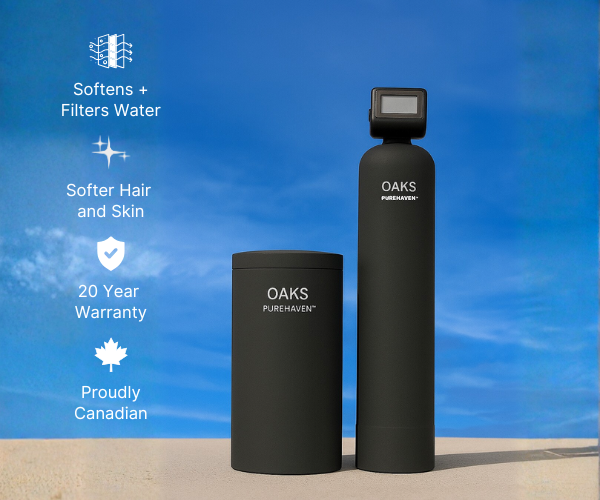
It is recommended to choose the OAKS PureHaven System or The Vital Home System, as they have all the features to be the best choice for you and your family.
Ready for Clean, Mineral-Balanced Water From Every Tap?
Protect your family’s health, skin, and home appliances. Let our technicians design a premium whole-house system that fits your budget perfectly.
A Quick Comparison between System Types
System Type | Filter Stages | Lifespan of filters used | Maintenance Level | Best For |
Whole-house sediment | 2 stages (sediments) | 3-6 months | Low | Well water with sediments
|
Whole-house carbon | 3 stages (carbon and sediments) | 6-12 months | low | Municipal water with chlorines and chloramines |
Whole-house hybrid | 4 stages (UV, carbon and sediments) | 12-24 months | moderate | Moderate Water with bacteria and viruses |
Whole-house and RO | 5 stages (RO, carbon and sediments) | 12 months | moderate | Moderate Water with high TDS levels |
Common Mistakes to Avoid When Buying a Whole House Filter
The following are the common mistakes that should be avoided, but people mostly make these mistakes:
- They choose and buy the water filter system without testing the water.
- They ignore the valid certification of the system.
- They choose an undersized system that does not meet their needs.
- They overlook the maintenance costs.
- They fall for marketing hype and do not look for the things they need to see.
- They prefer low-price systems over well-performing systems.
Who Should Invest in a Whole-House Water Filtration System?
You should invest in installing a whole-house water filtration system:
- If you have sensitive families with children.
- If you are health-conscious, you want to use clean water for every household chore.
- If you have homes with older plumbing systems that are rusted and can add rust and metals like lead, copper, and iron to water.
- If you are well-water users.
- If you are sensitive to chlorine and chloramines.
Conclusion
If you are living in Canada, you need to install a water filtration system to get healthy and clean water to protect your health, skin, hair, and home appliances.
Choose the best whole-house system according to your needs after testing the water quality.
Contact OAKS Wellness Water to install a whole-house water filter system (the OAKS PureHaven system for getting filtered water in every tap or The Vital Home System with an additional drinking system) for a better experience with a 20-year warranty and a 30-day risk-free trial.
Ready for Clean, Mineral-Balanced Water From Every Tap?
Protect your family’s health, skin, and home appliances. Let our technicians design a premium whole-house system that fits your budget perfectly.
FAQs about “Whole House Filter Guide”
Do whole-house water filtration systems remove PFAS in Canada?
Yes, an additional filter stage can be introduced in the whole-house water filtration system to remove PFAS.
Is whole-house filtration better than reverse osmosis?
Yes, it is better than the RO system, as it provides clean water in every tap of your home, but RO is just a point-of-use system.
It is better to use a hybrid of the whole house system with RO, where RO is used for drinking and cooking purposes.
How long do whole-house water filters last?
The main components (tank and valves) of whole-house water filters last 10-20 years, whereas the internal filters need to be changed every 3-12 months.
Are these systems safe for Canadian well water?
Yes, these systems are safer for Canadian well water, as they can provide cleaner and healthier water by using different stages.
Do whole-house filters affect water pressure?
Yes, whole-house filters lower water pressure by creating restrictions due to additional layers, but mostly modern OAKS systems have minimized the pressure drop.
Do I need professional installation in Canada?
Yes, for a better system installation in Canada, you need to contact a professional to install your whole-house water filter system.
Written by Joseph Mroueh
Joseph, founder of Oaks, develops high-quality whole-home and drinking-water filtration systems. He focuses on delivering reliable, clean, and safe water solutions for modern households.
Share